
Most people still talk about GTM like it’s a handoff.
Marketing “generates leads.”
Sales follows up.
Ops tries to keep it all connected.
That model breaks the moment you add more channels, more markets, or more volume.
You end up with messy data, random follow-ups, and a pipeline that’s hard to attribute or repeat.
In 2026, GTM is not a sequence of teams.
It’s a connected system.
Signals flow in.
Data gets cleaned and enriched automatically.
AI helps qualify and route.
Outreach triggers based on intent.
Replies get handled with context.
And revenue gets measured back to the actions that created it.
One note before we get into the flow:
This is one of the early, easier GTM systems you can build.
Not because it’s “simple,” but because it’s modular, high-impact, and you can improve it step-by-step without rebuilding everything later.
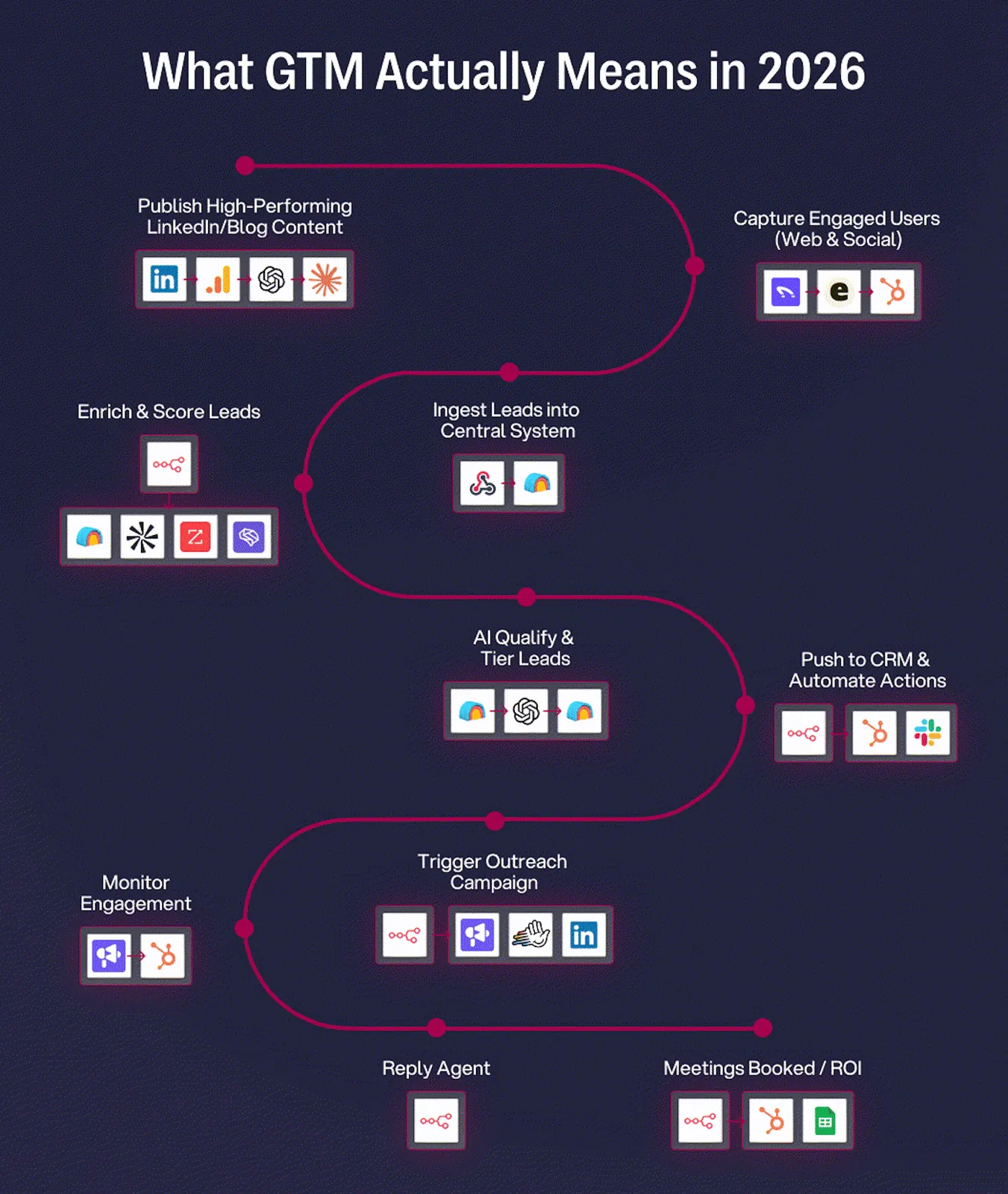
Here’s the practical version.
- 01Create demand where your buyers already areIn most B2B motions, that starts with consistent distribution on LinkedIn. ChatGPT and Claude help you write, edit, and repurpose faster. LinkedIn is the distribution channel (where the content actually gets consumed). GoogleAnalytics is the feedback loop (what content is driving visits, conversions, and demand over time).
- 02Turn engagement into identifiable leadsIn 2026, the goal isn’t “more traffic.” It’s capturing the right engagement and turning it into usable data. HubSpot captures website visitors, form fills, and lifecycle events. LeadShark converts LinkedIn interest into trackable lead flows (DMs, lead magnets, follow-ups). GoExtrovert turns content engagement into warm interactions so you’re not starting cold.
- 03Centralise the system of record before you scale anythingIf your data is split across tools, automation breaks. You want one place where every lead lands before it gets enriched, scored, or routed. For many teams, that hub is Clay.
- 04Enrich, score, and keep data clean automaticallyThis is where systems either compound or collapse. Enrichment isn’t a one-time task. It’s a continuous process: fill missing fields, validate, de-dupe, and score based on your ICP rules. n8n orchestrates the logic and routing. Clay manages the enrichment workflows and lead records. Then you pull from providers like Apollo, ZoomInfo, and PeopleDataLabs to keep coverage high and data usable.
- 05Use AI to qualify and tier leads, with reasonsAI becomes useful when it helps you make decisions faster, not just write messages. You can classify leads into Hot/Warm/Cold, tag the reason, and route based on what they’re showing. That’s ChatGPT (usually 4o mini) running inside n8n workflows, writing results back into Clay.
- 06Push clean data into CRM and trigger next actionsOnce a lead is qualified, you shouldn’t rely on someone to move it manually. n8n pushes updates to HubSpot, assigns owners, and triggers workflow steps. Slack is the alert layer so reps only get notified when something is worth actioning.
- 07Outreach runs off triggers, not “send schedules”Outbound works best when it’s timed to behaviour. Campaigns should launch because someone showed intent, not because a list hit a certain size. Smartlead runs high-volume email sequences. HeyReach runs LinkedIn sequences across seats. n8n coordinates triggers, pauses, and handoffs so outreach stays consistent.
- 08Measure ROI end-to-endThe final piece is attribution that’s actually usable. Not perfect, but clear enough to answer: “What created pipeline this month?”. Most teams use HubSpot reporting and simple rollups in GoogleSheets.
The point isn’t to collect tools.
It’s to build one continuous flow from signal → action → revenue.
If you’re building this right now, what’s the weakest link: capture, enrichment, routing, or execution?
If you need help building a system like this for your GTM team, we can help.
We design and implement connected revenue systems end-to-end, from content and signals to outbound, CRM, and reactivation.
Book a call with us and let’s map what this would look like inside your team.
Happy to walk you through it :)

Software, accelerator and startup background. Runs the GTM architecture side: how the system is designed, what it is built on, and where AI actually earns its place.
LinkedIn ↗YouTube ↗